Desert plants are species from arid regions that store water in stems or leaves, or shed it through tiny leaves, and live on a fraction of a lawn's irrigation. In UAE gardens they come together when chosen by shape. This guide names the ones that survive on almost no water, groups them by form, shows how to compose the groups into a planting scheme, and covers the soil and irrigation behind it.
Desert plants that survive on almost no water
Once established, agaves, columnar cactus, euphorbias, Texas sage and Parkinsonia survive a UAE year on one deep soak every 2 to 3 weeks in summer and none from December to February. They store water in thick tissue or cut losses through small, grey or waxy leaves.
Two storage types need telling apart. Succulents such as Agave americana and Cereus hold water in their tissue, so a single soak lasts weeks. Woody desert shrubs such as Leucophyllum frutescens hold very little but have fine, silvery leaves that reflect sun and lose water slowly.
Light matters as much as water. All of these plants want full sun, 8 hours or more, and in shade agaves stretch and lean toward the light while Texas sage stops flowering. A north facing strip beside the villa wall is the wrong place for a desert scheme.
The first summer is the exception for both. Every new planting needs weekly water from May to September while roots spread into the surrounding sand.
Grouping desert species by form
Desert species fall into 5 form groups: vertical columns, rosettes, rounded mounds, fine grasses and low spreaders. Choosing one or more plants from each group, instead of picking species one at a time, produces a scheme with height, contrast and ground cover. Each group does a different visual job.
- Columns give height and a focal point: Cereus repandus, Euphorbia ammak and Pachycereus marginatus.
- Rosettes give bold, spiky structure at mid height: Agave americana, Agave angustifolia and Hesperaloe parviflora.
- Mounds give soft, rounded mass: Leucophyllum frutescens, Euphorbia milii and Portulacaria afra.
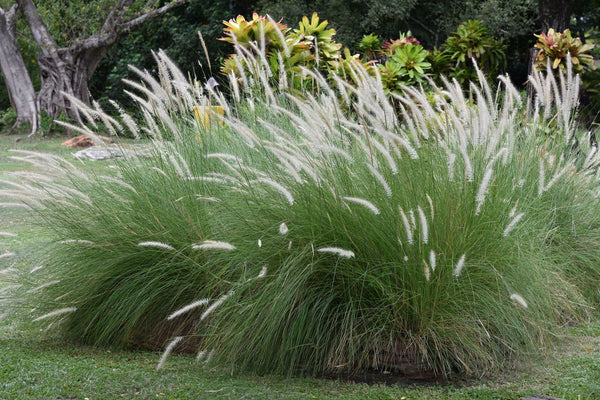
- Fine grasses give movement and a light texture: Pennisetum setaceum Rubrum and Muhlenbergia capillaris.
- Spreaders cover the ground between the others: Sesuvium portulacastrum, Aptenia cordifolia and Carpobrotus edulis.
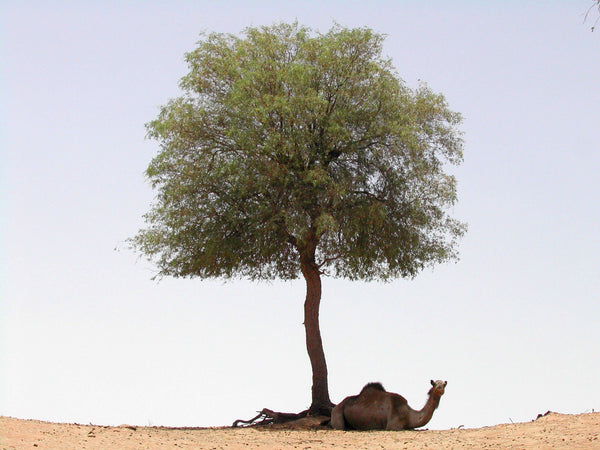
A sixth element sits over the scheme. A light canopy tree such as Parkinsonia aculeata casts dappled shade without blocking the sun the succulents need.
Composing a planting scheme from the forms
Compose a desert scheme by placing forms in a ratio of about 1 column to 3 rosettes to 5 mounds, then filling gaps with grasses and spreaders. Space every plant at its mature width, set tall forms at the back or centre, and repeat species rather than adding new ones.
- Place the columns first, in odd numbers, where the eye lands from the terrace or the gate.
- Ring each column with rosettes set in drifts of 3, offset so no two line up.
- Run mounds along the front and sides to soften the edge of the bed.
- Weave fine grasses between rosettes so their movement contrasts with the rigid leaves.
- Fill the remaining ground with spreaders and a layer of gravel, leaving the stems of succulents clear.
Leave space. A desert scheme with 40 percent open gravel between plants reads as intended, while one packed tight looks overgrown within 2 years because agaves double their width.
Colour comes from leaf, not flower. Pair blue grey agaves with the purple of fountain grass and the bright green of Portulacaria, and let Texas sage add its violet flowers after humid spells.
Boulders count as a form too. A single large rock half buried beside a column anchors it. For shrubs and succulents that fill the mound and grass groups, the drought tolerant plants range lists species suited to this scheme.
Soil and irrigation for a desert scheme
A desert scheme needs free draining native sand, a raised bed or mound for the succulents, and its own irrigation valve. Rot from standing water kills more desert plants in UAE gardens than drought does, especially where sprinklers from a neighbouring lawn reach the bed.
Don't add compost to the planting holes. Rich soil holds water around the base of an agave and rots it in the humid weeks of August. Raise succulents 15 to 20 cm above the surrounding grade so rainwater and irrigation drain away from the crown.
Run drip to the outer edge of each plant's spread, and taper the schedule to zero in winter. The columns and rosettes in the scheme are sold potted in the cactus and succulents range, and they settle fastest when planted out in November or February.
FAQ
Garden owners planning a desert bed ask first which plants will live without much water and then how to arrange them. Both answers are summarised below, with the counts and ratios carried over from the sections above so neither answer needs the rest of the page.
Which desert plants survive with almost no water?
Established agaves, columnar cactus such as Cereus, Euphorbia ammak, Texas sage and Parkinsonia survive on one deep soak every 2 to 3 weeks in a UAE summer and no water in midwinter. All of them need weekly watering through their first summer while roots establish.
How do you design with desert plants?
Design with desert plants by form. Choose from columns, rosettes, mounds, fine grasses and spreaders, place them at about 1 column to 3 rosettes to 5 mounds, space each at mature width, and leave around 40 percent of the bed as open gravel.
Was this guide helpful?