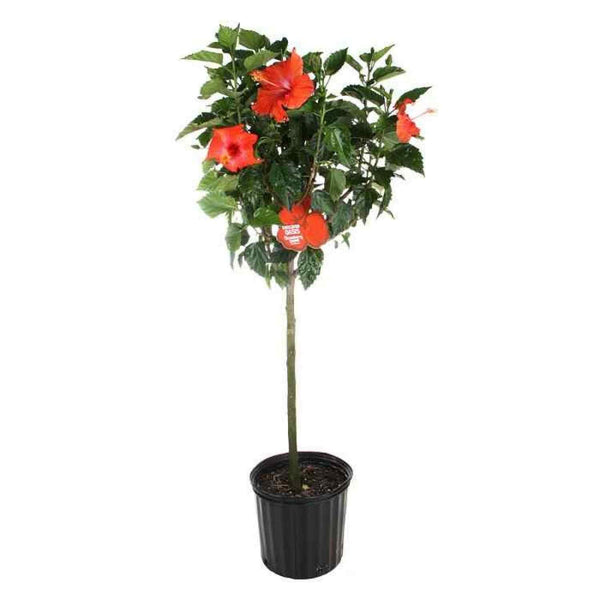
Hibiscus rosa-sinensis is a tropical flowering shrub that blooms almost all year in a UAE garden, provided its water supply stays steady. This guide covers why uneven watering makes it shed buds, how to set a watering routine for beds and pots, how much sun it takes here, and the other problems that show up on the leaves.
Why hibiscus drops its buds
Hibiscus drops its buds when the soil around its roots dries out and is then rewetted, even once. A developing bud takes water faster than any leaf, so when supply dips the plant cuts it off at the stalk. The bud yellows and falls three to five days later.
That delay is what confuses people. By the time buds lie on the paving, the soil has been watered again and feels fine.
Look at the stalk of a fallen bud. A clean break at a pale joint just below the bud is the abscission layer the plant forms on purpose. That points to a water swing. A bud that's soft, brown or hollow at the base points to a pest instead, usually a gall midge larva feeding inside.
Four watering patterns cause most of the swings in UAE gardens:
- A hand watering routine that skips a day in May or June, when a potted shrub can empty its root zone between breakfast and evening.
- A drip emitter sized for the shrub when it was planted, which now serves a canopy three times wider.
- A controller changed from the winter schedule to the summer one weeks after the heat has already arrived.
- A pot that's been rootbound for a season, so the mix dries in hours and water runs down the gap between root ball and wall.
Heat alone causes a smaller, separate drop. Above about 40C, open flowers last a single morning and the smallest buds abort. That's a July pattern on well watered plants, and it passes once nights cool.
How to water hibiscus in beds and pots
Water hibiscus so the root zone never fully dries: daily in summer and every two to three days in winter for a shrub in the ground on drip, and daily, sometimes twice, for a plant in a container through June to September. Consistency matters more than volume.
For a bed planted shrub about 1 m tall, two 4 L/h drip emitters placed either side of the stem, 20 cm out, cover the root spread. In summer that pair needs roughly 30 to 40 minutes a day. Add a third emitter each time the canopy widens by half a metre.
Pots are harder. A hibiscus in a 40 cm container on a sunny terrace can go from wet to bone dry in a single July day. Put that pot on a drip line or a double run: once before sunrise, once in the late afternoon.
A quick check tells you whether the routine is holding. At around 4 pm on a hot day, press a finger down 5 cm. If it's dry there, the morning dose isn't lasting, and bud drop will follow within the week.
Desalinated water leaves salt behind in a container. Once a month, run enough water through the pot that a good flow drains out of the base, which carries the build up away from the roots.
Salt, heat and sand act on every outdoor shrub here. For how those conditions shape a routine, read the UAE plant care guide, written for the Emirates.
How much sun hibiscus needs in the UAE
Hibiscus needs at least six hours of direct sun to flower well in the UAE, and it flowers most in full sun from October to May. From June to September, a spot with morning sun and shade after about 1 pm keeps it blooming without scorching.
Too little light shows as long gaps between leaves and few buds. A hibiscus under a dense tree canopy or against a north wall grows leaves and not much else.
Too much summer sun shows as bleached, papery patches on the leaves that face west. It rarely kills the shrub, but it slows flowering through August.
An east facing bed is the easiest position in a villa garden. A south facing bed works if a taller shrub or pergola breaks the afternoon sun.
Common hibiscus problems besides bud drop
The 4 common hibiscus problems in UAE gardens, other than bud drop, are whitefly, pink hibiscus mealybug, yellow leaves from overwatering and salt burn along the leaf edge. Each one leaves a distinct mark, so it's worth reading the leaf before reaching for a spray.
- Whitefly shows as a cloud of tiny white insects rising when the branch is shaken, with sticky honeydew and black sooty mould on the leaves below.
- Pink hibiscus mealybug shows as white waxy clusters on new shoots, which then twist and stop growing.
- Overwatering shows as older leaves turning evenly yellow and falling, with soil that's still wet a day after watering.
- Salt burn shows as a brown, crisp margin on older leaves, often in pots that are never flushed.
Pests go for stressed shrubs first. An evenly watered hibiscus, fed lightly every four weeks from October to May, shrugs off infestations that finish a thirsty one.
Replacing a tired plant is often quicker than rescuing it. Nursery grown hibiscus planted in October has eight cool months to settle in before its first summer.
FAQ
Once a hibiscus starts sulking, its owner wants three answers fast. The short answers below cover watering, sun and trouble spotting, and the sections above give the method behind each one when the quick version isn't enough.
How do you water hibiscus?
Keep the root zone evenly moist, never letting it dry out completely. In the ground on drip, water daily in summer and every two to three days in winter. In pots, water daily from June to September, twice on the hottest days, and flush the pot monthly.
How much light does hibiscus need?
Give hibiscus at least six hours of direct sun. Full sun suits it from October to May. In summer, morning sun with shade after about 1 pm keeps the flowers coming and stops the west facing leaves from bleaching.
What are the common problems with hibiscus?
Bud drop from uneven watering is the top one. After that come whitefly, pink hibiscus mealybug on new shoots, yellowing from overwatering, and brown salt burn on leaf edges in pots. Each leaves a distinct sign, so identify it before treating.
Was this guide helpful?