Low-water plants are species that stay healthy on a fraction of the water a lawn or hibiscus hedge needs, and in Dubai that fraction can be put in litres. This guide shows how to calculate a plant's water use, gives litres per plant per week for 9 species in July and January, works out the saving from a swap, and covers what the figures leave out.
How plant water use is worked out
A plant's water use is worked out by multiplying the local reference evaporation by a plant factor and by the plant's canopy area. In Dubai the reference evaporation runs about 9 mm a day in July and about 3 mm a day in January, and 1 mm over 1 square metre equals 1 litre.
The reference figure describes a short, well watered grass. The plant factor scales it for each species. Low water desert shrubs sit around 0.1 to 0.3, moderate shrubs around 0.4 to 0.6, and lawns and thirsty flowering hedges around 0.6 to 0.8.
Canopy area is the third term. A shrub 1.5 m across covers about 1.8 square metres, so it uses 1.8 times the water of a 1 square metre plant with the same factor.
Each result below is an estimate for an established plant on sandy soil. Wind, reflected heat off paving and a first year root system all push it up.
Litres per plant per week for 9 species
An established Agave americana 1.5 m across uses about 11 litres a week in July and 4 in January, while a Dodonaea viscosa hedge plant the same width uses about 22 and 7. The 9 species below are ranked from lowest to highest July use per plant, with the canopy width each figure assumes.
- Aloe vera, a clump 0.6 m across, uses about 2 litres a week in July and under 1 in January.
- Portulacaria afra, 1 m across, uses about 10 litres in July and 3 in January.
- Agave americana, 1.5 m across, uses about 11 litres in July and 4 in January.
- Sesuvium portulacastrum groundcover uses about 13 litres per square metre in July and 4 in January.
- Leucophyllum frutescens, 1.2 m across, uses about 14 litres in July and 5 in January.
- Tecoma stans, 1.2 m across, uses about 21 litres in July and 7 in January.
- Dodonaea viscosa, 1.5 m across, uses about 22 litres in July and 7 in January.
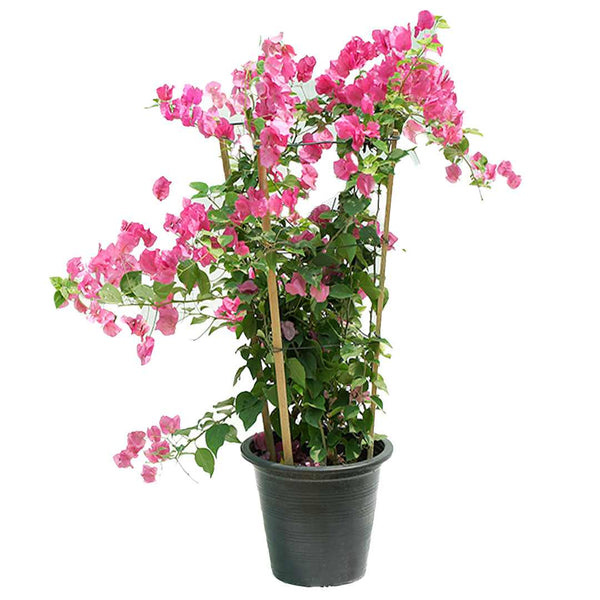
- Bougainvillea as a free standing shrub 1.5 m across uses about 33 litres in July and 11 in January.
- Prosopis cineraria, a young ghaf 3 m across, uses about 45 litres in July and 15 in January.
The ghaf looks thirsty on that list only because it's big. Per square metre of shade it uses the same as the agave, which is why a tree can be the most water efficient way to cover ground.
For comparison, a hibiscus 1.2 m across with a factor of 0.6 uses about 43 litres a week in July. A square metre of Paspalum lawn uses about 44.
How much water a switch saves
Swapping 10 hibiscus shrubs for 10 Leucophyllum frutescens of the same 1.2 m width saves about 285 litres a week in July and about 95 litres a week in January. The saving comes from the plant factor alone, 0.6 down to 0.2, with the canopy area held the same.
Lawn is where the numbers get large. Replacing 20 square metres of Paspalum with Sesuvium groundcover saves roughly 630 litres a week in July.
These savings only arrive if the irrigation is cut to match. A low water plant on the same drip timer as the hibiscus it replaced uses exactly as much water, and the surplus drains past the roots. Resetting run times per valve after a planting change is part of the work that irrigation services cover.
What the figures leave out
The litres above leave out 3 things: the extra water a plant needs in its first year, the losses from the irrigation system, and the salt flushing that saline water demands. Each one adds to the base figure, so treat the list as a floor for an established plant, not a target for a new one.
For the first 6 to 12 months, a low water shrub behaves like a moderate one, with a factor closer to 0.5, until its roots reach beyond the planting hole. Drip loses about 10 percent. And desalinated or well water needs an occasional deeper watering to push salt below the root zone.
Every species in the drought tolerant plants collection sits in the low factor band, so any of them can replace a thirsty shrub and cut the weekly figure.
FAQ
After the litre figures, the questions shift to ranking and to scale. The two below take the numbers above and answer them directly for a Dubai villa garden, with no new assumptions added beyond those already stated in the calculation section.
Which plants need the least water in Dubai?
Aloe, agave and native Sesuvium need the least water in Dubai, each with a plant factor near 0.1 to 0.2. Per plant, a small aloe clump uses about 2 litres a week in July. Among shrubs, Leucophyllum frutescens uses the least, about 14 litres a week at 1.2 m wide.
How much water does a low water garden save compared with lawn?
A low water garden saves about 31 litres per square metre per week in July compared with Paspalum lawn, using a groundcover such as Sesuvium. Across a 100 square metre garden that's roughly 3,150 litres a week at the peak of summer, before counting irrigation losses.
Was this guide helpful?