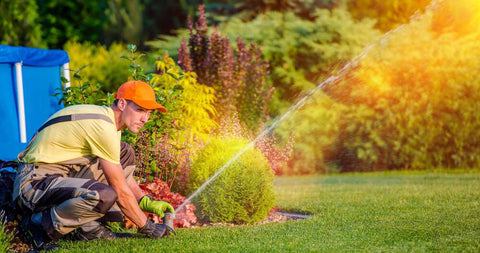
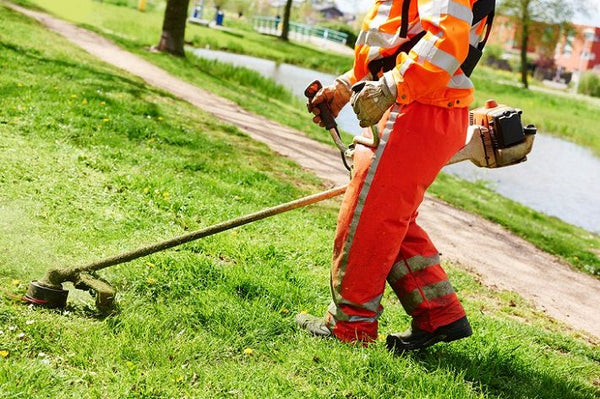
Drip and sprinkler irrigation are the two main ways to water a Dubai garden: drip feeds water to each plant at soil level, while sprinklers throw it through the air over a whole area. This comparison puts a number on the water gap between them, explains why UAE heat widens it, then covers lawns and how the two systems share one garden.
The water gap in numbers
The water gap runs at roughly 25 to 45 percent in drip's favour for shrub and tree beds in a Dubai summer. Drip puts about 85 to 90 percent of what leaves the pipe into the root zone. Spray sprinklers in hot, dry, windy conditions manage about 50 to 65 percent.
Those efficiency ranges are estimates from general irrigation engineering, where application efficiency means the share of water that ends up where roots can use it. The spread depends on wind, time of day, nozzle type and how well the system was laid out.
Take a shrub bed that needs 100 L a day at the roots. Drip at 88 percent has to release about 114 L. A spray zone at 55 percent has to release about 182 L. That's 68 L more every day, or around 37 percent less water for drip, for exactly the same plants.
Rotor sprinklers, the larger heads that throw a single stream in an arc, sit between the two, at around 65 to 75 percent. They lose less to drift than a fine spray does, which makes them the better sprinkler for lawns.
Why UAE heat widens the gap
UAE heat widens the gap because sprinkler water spends time in hot, dry air and on sun baked surfaces before it reaches roots, and drip water doesn't. At 40C with low humidity, the fine droplets from a spray nozzle lose water in flight and drift in the smallest breeze.
Sprinkler water is lost by 4 routes that drip mostly avoids:
- Evaporation in the air, as droplets heat on their way to the ground.
- Wind drift, which carries fine spray onto walls, paths and the neighbour's plot.
- Evaporation from wet leaves and the whole wetted surface, including sand between plants where no roots sit.
- Overspray and runoff onto paving and driveways, which bakes off within minutes in summer.
Every route scales with heat. The same spray zone that loses a third of its water on a calm January morning can lose close to half on a July day with a shamal blowing. Drip releases water under the mulch or at the soil surface, so the air temperature barely touches it.
Salt adds a second cost. Sprinkler water on leaves evaporates and leaves its minerals on the leaf surface, which shows up as scorched edges on shrubs such as hibiscus. Drip keeps saline water off the foliage entirely.
Why lawns stay on sprinklers
Lawns stay on sprinklers, specifically rotor heads for open areas and fixed spray heads for narrow strips. Grass needs water spread evenly across every square centimetre of its surface, and overlapping sprinkler arcs do that. Drip emitters at points can't cover turf evenly on sandy soil.
Subsurface drip for lawns does exist. Lines are buried 10 to 15 cm deep in a close grid. On UAE sand, though, water drops straight down from each emitter rather than spreading sideways, so the grid has to be tight, around 30 cm between lines, or the lawn shows green stripes over each pipe.
Subsurface systems also make new sod harder to establish, because the surface stays dry until roots reach the pipe. Most lawns are laid with sprinklers for that reason, and the water saving comes from better sprinkler practice instead:
- Head to head spacing, so each sprinkler's spray reaches the next head.
- Rotors on open lawn, keeping fine sprays for strips under 3 m wide.
- Pressure regulated heads, which make larger droplets that drift less.
- Cycles run before sunrise, when air is coolest and winds are lightest.
Running drip and sprinklers in one garden
A Dubai garden with lawn and planted beds runs both systems: sprinklers on the lawn, drip on shrubs, trees, hedges and pots. Each sits on its own controller zone with its own schedule, because a lawn and a hedge need different volumes at different intervals.
The common mistake is sprinklers doing double duty. A spray head at the lawn edge that also wets a hedge line gives the hedge far too little water in the root zone, salt on its leaves, and a wet trunk base that invites rot.
Converting a bed from sprinkler to drip is usually simple. The existing zone valve and pipe stay, the spray heads get capped, and a drip adaptor feeds a new lateral into the bed. The bed then needs a new run time, since drip runs longer at lower flow.
Deciding which areas get which system depends on the plot layout, lawn size and supply pressure. For that zoning work, irrigation services can map each zone to the right method and set a schedule for both, so lawn and beds each get what they need.
FAQ
Villa owners comparing the two systems usually want to settle two things before changing anything in the garden. Short answers to both follow here, with the numbers and the reasoning laid out in the comparison sections above for anyone wanting the full working.
Does drip or sprinkler irrigation use less water?
Drip uses less, by roughly 25 to 45 percent for beds in a Dubai summer. Drip puts about 85 to 90 percent of its water into the root zone. Spray sprinklers manage about 50 to 65 percent in hot, windy conditions, losing the rest to evaporation and drift.
Is drip or sprinkler better for a lawn?
Sprinklers are the standard choice for lawns, using rotor heads on open areas and spray heads on narrow strips. Grass needs even coverage that point emitters can't give on sandy soil. Subsurface drip works only with lines about 30 cm apart, and it slows new sod.
Was this guide helpful?