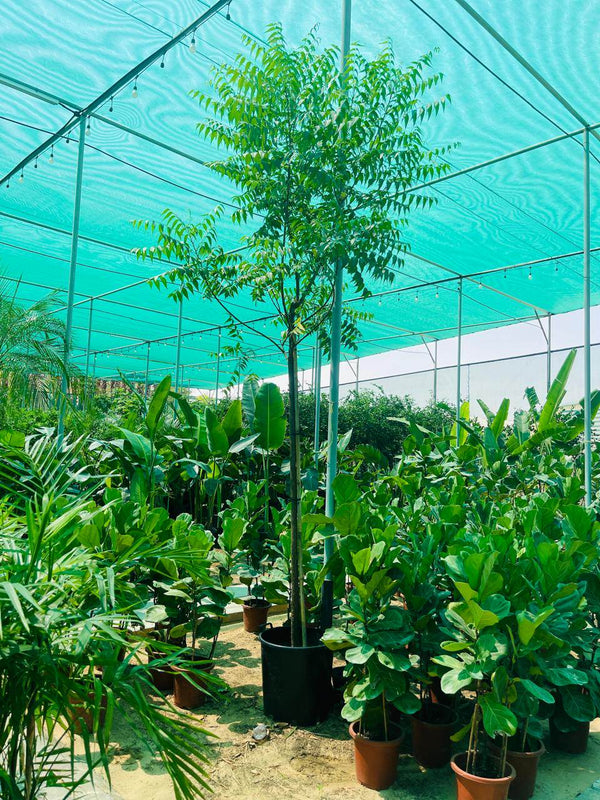
A windbreak is a row of trees or shrubs planted across the wind to slow it over the ground behind, and on open UAE plots it also cuts blowing sand. This guide explains how a windbreak works, how far downwind the shelter reaches as a multiple of height, the spacing and row layout that holds, and which species fit the Gulf's wind and salt.
How a windbreak works
A windbreak works by letting part of the wind through its foliage while pushing the rest up and over, so the air behind it moves slower without tumbling. The ideal is about 40 to 50 percent porous. A solid wall shelters a short strip well, then creates eddies that swirl dust behind it.
Think of the porosity as the share of sky visible through the row when standing at right angles to it. A 50 percent row looks half foliage, half gaps.
That's why a planted windbreak often beats a boundary wall on a big plot. The wall stops the air dead at its base, but within a short distance the wind drops back down behind it with turbulence, lifting sand. A porous row bleeds air through and keeps the flow smooth for much longer.
Protected distance as a multiple of height
A windbreak shelters ground downwind for about 10 times its own height with a clear reduction, and a measurable one reaches 20 to 25 times. It also slows the wind in front by 2 to 5 heights. Height is the unit, so a row twice as tall shelters twice the distance.
For a row of medium density, around 40 to 60 percent porous, the reduction falls off roughly like this:
- At 2 to 5 heights downwind, wind speed drops by about half.
- At 10 heights downwind, wind speed drops by about a third.
- At 20 heights downwind, wind speed drops by 10 to 15 percent.
- Beyond about 25 heights, the effect is gone.
These are typical figures from windbreak research on farms and plots, not promises for a particular site. Gaps in the row, a building nearby or a slope all move them.
Two worked examples make the rule concrete. A 2 m hedge along a villa boundary halves the wind for 4 to 10 m behind it and still takes the edge off at 20 m. A 6 m line of trees on a farm plot halves the wind across 12 to 30 m and gives useful shelter to about 60 m, enough to cover a shade house or a vegetable block.
Spacing, rows and length
Plant a single windbreak row with shrubs 1 to 1.5 m apart or trees 2.5 to 3 m apart, and add a second staggered row 2 to 3 m behind where space allows. Make the line at least 10 times as long as it is tall, because wind wraps round the ends and shortens the sheltered zone.
Two rows beat one. The first row takes the wind and the second fills its gaps, holding the porosity steady as individual trees thin or die back.
Orientation comes before spacing. Set the row across the prevailing wind, which on most of the UAE plain is the north westerly shamal, and on the coast also the afternoon sea breeze from the north or north west. A windbreak parallel to the wind shelters nothing.
Keep foliage to the ground. A tree row that loses its lower branches turns into a wind tunnel at the base, so plant a low shrub row in front of any tall species.
Species that hold up to Gulf wind and salt
Windbreak species here need 3 traits together: tolerance of saline soil and water, flexible branches that bend instead of snapping, and foliage that stays evergreen. Tamarix aphylla, Casuarina, Ficus nitida, Prosopis cineraria and Dodonaea viscosa all meet that test in UAE conditions.
Tamarix aphylla, the athel tamarisk, is the classic desert windbreak and handles salt spray and saline groundwater. Casuarina gives height fastest. Ghaf, Prosopis cineraria, is slow but native and deep rooted. Dodonaea viscosa fills the low front row, clipped to 1.5 to 2 m.
The privacy and shade trees collection carries the tree species for the main row from young stock up to taller starting heights.
Mix at least 2 species in any row longer than 30 m. A single species line fails all at once if one pest or one dry spell hits it, and the gap it leaves is the width of the whole windbreak.
FAQ
Owners of exposed plots usually raise sand and the number of rows once the height rule is clear. Both are answered below in short form, using the same multiples of height as above, so each answer can be checked against a sketch of the plot.
Does a windbreak stop blowing sand?
Yes, a windbreak cuts blowing sand, because sand only moves once the wind near the ground passes a threshold speed. Halving that speed for 2 to 5 heights behind the row drops most of the moving grains there, so expect a band of deposited sand just downwind that needs raking.
Is one row of windbreak trees enough?
One row is enough on a small villa plot if the trees sit 2.5 to 3 m apart and a shrub row closes the base. On an open farm or estate plot, two staggered rows hold their porosity far better as single trees fail, so a gap never opens up in the shelter.
Setting out a double row with its drip line on a large plot is the kind of job a landscaping service plans from a site survey.
Was this guide helpful?