Plants reduce noise, but a villa hedge removes far less than garden marketing suggests. This guide gives the honest decibel figure for hedges and tree belts, explains what those decibels mean to the ear, covers how dense and deep planting has to be, and shows what to pair with planting when a road or a construction site sits next door.
How much noise plants remove
A single hedge row 1 to 2 m deep typically removes 1 to 3 decibels of road noise. A belt of dense trees and shrubs 30 m deep removes roughly 5 to 10 decibels. Those figures come from outdoor field measurements of tree belts and are rules of thumb, varying with species and traffic.
The claim repeated in garden adverts, that a hedge halves noise, needs about 10 decibels. On a villa plot that means a planted strip deeper than most gardens are wide.
Depth does the work because sound loses energy gradually as it passes stems, branches and leaves. Averaged across a dense belt, that loss runs at roughly 0.2 to 0.3 decibels per metre. A 1.5 m boundary hedge gets through perhaps half a decibel from the foliage itself, and most of its small effect comes from the ground and from blocking the direct line.
What those decibels mean to the ear
A 3 decibel drop is the smallest change most people notice, 5 decibels is clearly noticeable, and 10 decibels sounds roughly half as loud. The decibel scale is logarithmic, so a 3 decibel cut halves the sound energy while the ear hears only a slight step down.
Set a single hedge row against that scale. At 1 to 3 decibels it sits at or below the point where the change is noticed at all. A deep tree belt reaches the clearly noticeable band, and the widest belts touch the half as loud mark.
Frequency shifts the result. Leaves scatter high pitched sound above about 1,000 hertz well, so tyre hiss and voices drop more than the figures suggest. The low rumble of trucks and generators passes through foliage almost untouched.
How dense and deep planting needs to be
Planting cuts the most noise when it's dense from the ground to the top with no gaps, and as deep as the plot allows. Four conditions decide the result: depth of the planted strip, foliage reaching the soil, evergreen species, and soft mulched ground beneath instead of paving.
Gaps matter more than anything else. A hedge with bare stems at the bottom 50 cm lets road noise straight under it, so underplant tall species with a low shrub row. Soft ground adds a little too, because loose, mulched soil absorbs sound that hard paving would bounce.
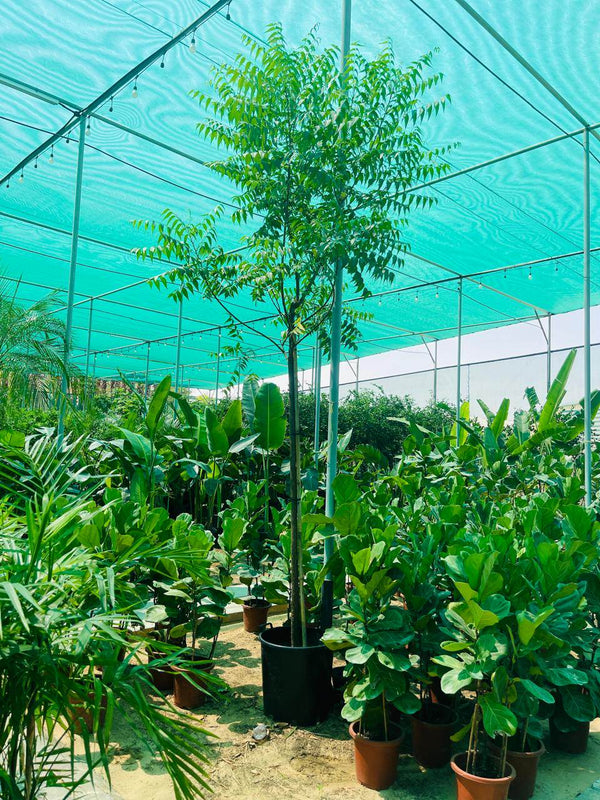
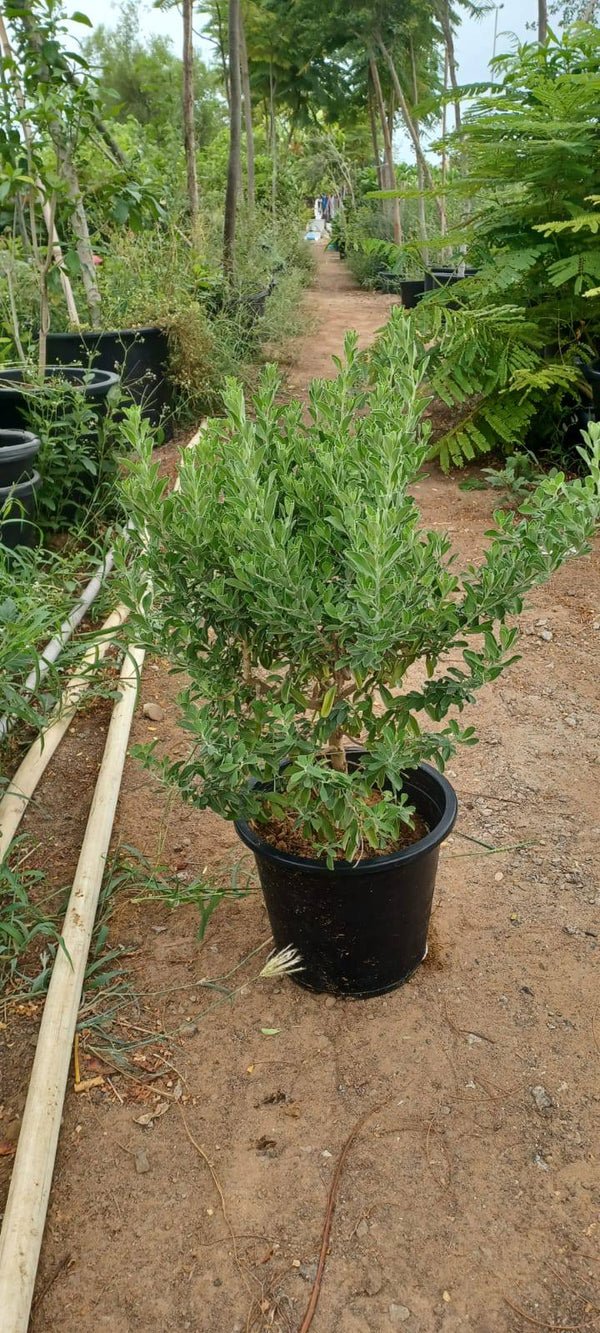
Evergreen species keep the screen working all year. In UAE villa gardens that points to Ficus nitida, Dodonaea viscosa and Callistemon viminalis, planted in 2 staggered rows about 1 m apart where the plot is deep enough. The privacy and shade trees range covers the taller species for the back row.
What to pair with planting
A solid wall that blocks the line of sight to the road cuts noise far more than planting, typically about 5 decibels once the source is hidden and roughly 1.5 more for each extra metre of height. Planting in front of the wall then softens reflections, and a green wall on a hard facade reduces echo inside a courtyard.
Mass is what stops sound. Blockwork, concrete and glass stop it, and leaves do not. So the order of work on a noisy plot is wall first, planting second.
Hard courtyards make noise worse by bouncing it between walls. Covering one of those walls in foliage breaks up the reflections. For that job a green wall installation covers a vertical surface with planting and irrigation without taking floor space from a narrow side yard.
Distance from the road beats any hedge. Sound from a line of traffic drops by about 3 decibels each time the distance doubles, so moving a seating area from 10 m to 20 m back gains as much as the typical hedge does. On a villa plot, put the quiet uses, majlis and bedrooms, on the far side of the house and plant the road side for looks.
Masking is the last tool. A small water feature near the seating area adds a steady sound that makes intermittent traffic harder to pick out. It doesn't lower the decibels. It changes what the ear attends to.
FAQ
People considering a planted noise screen tend to ask two things before spending on it. The answers below are short and stick to what can be measured, with no promise that planting alone will quieten a busy road next to a villa.
Do plants actually work for noise?
Yes, plants work for noise, but only in small amounts at villa scale. A single hedge removes 1 to 3 decibels, around the threshold of hearing a difference. Planting earns its place as a partner to a solid wall and as a way to cut echo in hard courtyards.
What is the quietest hedge to plant against a road?
The quietest hedge is the densest evergreen one with leaves down to the ground, planted in 2 staggered rows. Ficus nitida clipped to a solid face does this well. Species matter less than the gaps, so fill the base first before worrying about which leaf shape scatters more sound.
Was this guide helpful?