Full sun in a UAE summer means air in the mid forties Celsius and sun from dawn to late afternoon. The plants that survive it can be picked out by their leaves before you buy them. This guide explains why leaves fail in extreme heat, the five leaf traits that predict survival, how to screen plants with them, and which common species pass or fail.
Why leaves fail in extreme heat
Leaves fail in extreme heat when they absorb more energy than they can shed, and the leaf tissue cooks. A leaf loses heat three ways: to the moving air around it, by evaporating water through its pores, and by reflecting sunlight before it is absorbed. Leaf structure controls all three.
In a UAE July the evaporation route gets unreliable, because a plant short of water closes its pores to save what it has, and the cooling stops at exactly the hottest hour. The plants that survive rely on the other two routes, or on shapes that absorb less in the first place.
That is why a well watered banana still scorches at 45C. Its leaves are wide, thin and dark green, so they absorb heavily, hold a thick layer of still air against the surface, and depend almost entirely on evaporation to stay cool.
Five leaf traits that predict heat survival
Five leaf traits predict whether a plant will survive full UAE sun: small or narrow leaf size, a thick waxy coating, a silver or grey surface, fine hairs, and succulent water storage. Each one cuts the heat a leaf absorbs or speeds the heat it sheds without relying on water.
- Small or narrow leaves, under about 2 cm across, have a thin layer of still air at the surface, so moving air carries heat away quickly and the leaf stays close to air temperature.
- A thick waxy cuticle, the shiny skin on leaves like oleander, cuts water loss once the pores close and reflects part of the sunlight.
- A silver or grey surface, as on olive and Leucophyllum, reflects far more light than dark green does, so less energy is absorbed.
- Fine hairs, the felt on Calotropis and Leucophyllum, scatter light and hold a sheltering layer that slows water loss.
- Succulent leaves, as on aloe and Portulacaria, store water and open their pores at night, so the plant never has to trade water for cooling at midday.
A sixth feature helps, leaves held at a steep angle, which catch less of the overhead summer sun. It shows up on Casuarina, whose green twigs do the work of leaves, and on Eucalyptus camaldulensis.
How to screen a plant by its leaves
Screen a plant by counting which of the five traits its leaves carry. A plant with two or more survives full UAE summer sun once established. A plant with one needs afternoon shade from May to September. A plant with none belongs in part shade or indoors, however it looked in the nursery.
The screen works in a garden centre with no label. Look at leaf width, then rub a leaf between your fingers for wax or felt, then hold it against the sky to judge colour and thickness. It takes under a minute per plant.
Two cautions apply. First, a new plant of any kind needs extra water for its first summer, because a small root system can't supply even a tough leaf. Second, trait count predicts heat survival and says nothing about flowering. A plant can pass with four traits and still flower less in July.
Plants that pass and plants that fail
Applied to common UAE garden species, the screen passes Leucophyllum, oleander, olive, Calotropis, aloe, Portulacaria, Tecoma stans and Dodonaea, and fails banana, Monstera, Alocasia and Colocasia. Every plant in the passing group carries two traits or more, and none in the failing group carries more than one.
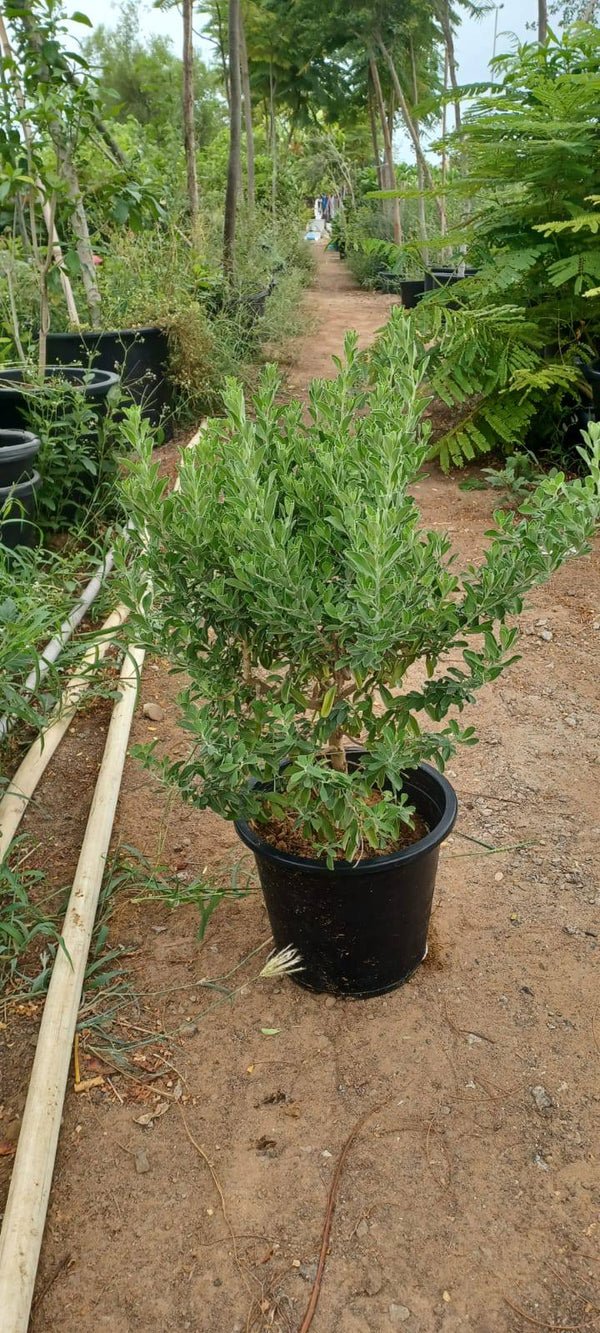
- Leucophyllum frutescens, Texas sage, scores three: small, silver and hairy.
- Olive scores three: narrow, waxy and silver backed.
- Oleander scores two, narrow and heavily waxed, though its sap is toxic, so it suits gardens without small children.
- Calotropis procera, native to the UAE, scores three: waxy, grey and felted.
- Aloe scores three: succulent, waxy and grey green.
- Portulacaria scores three: succulent, small and waxy.
- Tecoma stans and Dodonaea score two each, on narrow leaves and a glossy or resinous coat.
Ghaf, Prosopis cineraria, is the national tree and a native of UAE sand. It passes with two traits, tiny leaflets and a grey green surface. When you plant any of these, the drought tolerant plants range groups the high scorers that also cope on low irrigation once established.
Using the screen for a whole bed
A full sun bed in the UAE works when every plant in it scores two or more. Mixing a single low scorer into a bed of tough plants means irrigating the whole bed to that one plant's needs, which wastes water on the rest and keeps the soil wetter than the tough plants like.
Group plants by score as well as by look. Put the three trait plants on the west and south edges where the afternoon sun hits hardest, and the two trait plants nearer walls or trees that cast late shade. Anything you love that scores lower goes into a pot you can move into shade from May to September. The outdoor plants collection covers both groups, so compare leaf photos against the five traits before choosing.
FAQ
A single question sits behind most searches for heat proof plants, and it has a short answer. Once the leaf screen is clear, the answer below names the survivors directly for readers who want a list rather than a method.
What survives 45C in full sun?
Plants with two or more heat traits in their leaves survive 45C in full sun, once established. In UAE gardens that means Leucophyllum, olive, oleander, Calotropis, ghaf, aloe, Portulacaria, Tecoma stans and Dodonaea. Large, thin, dark green leaves such as banana and Monstera scorch at that temperature however much they are watered.
Does watering more help a plant survive full sun?
No, extra water helps only plants whose leaves can use it for cooling, and a large thin leaf still absorbs more heat than evaporation removes at 45C. Overwatering a heat tolerant plant does the opposite, since sandy beds kept constantly wet rot the roots of olive, aloe and Leucophyllum.
Was this guide helpful?